

Safety & Compliance · July 2026
PPE Requirements in Nigeria: The Complete Guide for HSE Officers & Procurement Teams
Whether you manage a construction site in Lagos, an oil & gas facility in Port Harcourt, or a manufacturing plant in Kano — understanding Nigeria's PPE requirements is not optional. This guide breaks down what the law demands, what your workers need, and how to source compliant equipment in Nigeria.
Why PPE Compliance Matters in Nigeria
Workplace injuries cost Nigerian businesses billions of naira annually in lost productivity, medical bills, and legal liability. According to the International Labour Organization (ILO), Sub-Saharan Africa records some of the highest rates of occupational fatalities globally — and Nigeria's construction, oil & gas, and manufacturing sectors are among the most hazardous.
Beyond the human cost, non-compliance with PPE regulations exposes companies to:
- Fines and shutdowns by the Federal Ministry of Labour & Employment
- Loss of operating licenses in regulated industries (oil & gas, construction)
- Civil lawsuits from injured workers or their families
- Reputational damage that affects contracts and partnerships
The good news? Compliance is straightforward when you understand the requirements and source the right equipment.
The Legal Framework: Nigerian Laws & Standards
PPE requirements in Nigeria are governed by several overlapping regulations:
🏛️ Factories Act (Cap F1, LFN 2004)
The primary legislation governing workplace safety in Nigerian factories. It mandates employers to provide adequate PPE for all workers exposed to hazardous conditions, free of charge.
⛽ DPR/NUPRC Regulations (Oil & Gas)
The Nigerian Upstream Petroleum Regulatory Commission (NUPRC) enforces strict HSE standards for upstream oil & gas operations, including mandatory PPE for all personnel on site.
🏗️ National Building Code (2006)
Requires construction site operators to enforce PPE use for all workers, including hard hats, safety boots, high-visibility vests, and fall protection equipment.
🌍 International Standards (ISO/EN)
Many Nigerian companies — especially those with international clients — require PPE certified to European (EN) or international (ISO) standards. Look for CE marking and EN certifications on all equipment.
PPE Requirements by Industry
| Industry | Mandatory PPE | Recommended Standard |
|---|---|---|
| Construction | Hard hat, safety boots (steel toe), hi-vis vest, gloves, safety glasses | EN 397, S1P/S3, EN ISO 20471 |
| Oil & Gas | FR coverall, safety boots (anti-static), hard hat, gas detector, gloves, goggles | EN 11612, EN 13034, ATEX |
| Manufacturing | Safety boots, gloves, ear protection, safety glasses, dust masks | EN 388, EN 352, EN 166 |
| Welding | Welding helmet, FR gloves, leather apron, safety boots, respirator | EN 175, EN 12477 |
| Healthcare | Gloves, face mask/respirator, gown, face shield, safety footwear | EN 455, FFP2/FFP3, EN 14126 |
Essential PPE Categories Explained
Head Protection
Safety helmets protect against falling objects, electrical hazards, and impact. Look for EN 397-certified hard hats. For bump hazards in confined spaces, bump caps (EN 812) are appropriate.
Eye & Face Protection
Safety glasses, goggles, and face shields protect against chemical splashes, flying debris, and UV radiation. EN 166 is the key standard for industrial eye protection.
Hand Protection
Gloves are the most commonly required PPE. Different tasks need different gloves — cut-resistant (EN 388), chemical-resistant (EN 374), or heat-resistant (EN 407). Never use one glove type for all hazards.
Foot Protection
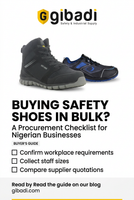
Safety boots with steel or composite toe caps (S1P, S3 ratings) are mandatory on most industrial sites. S3 boots add penetration resistance and waterproofing — ideal for Nigerian wet season conditions.
Body Protection
Hi-vis vests (EN ISO 20471), coveralls, and flame-resistant (FR) garments protect the body. FR coveralls are non-negotiable in oil & gas environments where flash fire risk exists.
Hearing Protection
Earplugs and earmuffs (EN 352) are required when noise levels exceed 85 dB. Generator rooms, drilling sites, and heavy manufacturing environments almost always exceed this threshold.
How to Choose the Right PPE: A Practical Checklist
Choosing PPE is not about buying the cheapest option — it's about matching the right protection to the specific hazard. Use this checklist:
✅ PPE Selection Checklist
- Conduct a hazard risk assessment for each job role and work area
- Identify the specific hazard type (impact, chemical, electrical, thermal, biological)
- Match PPE to the hazard — check the EN/ISO certification on the product
- Ensure the PPE fits correctly — ill-fitting PPE offers false protection
- Train workers on correct use, maintenance, and storage
- Establish a replacement schedule — PPE degrades over time
- Keep inspection records for audits and compliance documentation
"The most expensive PPE is the one that doesn't get worn. Comfort and fit drive compliance — invest in quality your workers will actually use."
Where to Buy Certified PPE in Nigeria
Sourcing genuine, certified PPE in Nigeria can be challenging — the market is flooded with substandard counterfeits that look the part but fail when it matters most. Here's what to look for in a reliable supplier:
- Verified certifications: Products should carry CE marking and EN/ISO certification numbers — not just printed logos
- Reputable brands: Portwest, 3M, Bosch, Knipex, Safety Jogger, and Milwaukee are globally trusted brands with proven track records
- Transparent product information: A good supplier provides full product specs, safety ratings, and datasheets
- After-sales support: Bulk orders, replacement parts, and HSE consultation support matter for large teams