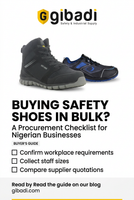


Buying safety shoes for a team takes more than choosing a design and multiplying the price by the number of workers. Procurement teams need to match footwear to workplace requirements, collect accurate sizes and compare supplier quotations on the same basis.
Whether you are sourcing footwear for a construction project, warehouse, factory or maintenance team in Nigeria, a clear purchasing brief helps reduce avoidable mistakes.
This guide walks through what to prepare before requesting a bulk safety-shoe quotation.
1. Start with the work environment
Before comparing brands or prices, confirm where and how the footwear will be used.
A warehouse team, an outdoor construction crew and a maintenance department may have different requirements. Buying one model for everyone can overlook important differences between roles.
Ask your site supervisor or health and safety lead to document:
- The tasks each team performs.
- The surfaces and working conditions they encounter.
- The footwear specifications required by the site.
- Any relevant employer or client purchasing requirements.
Use the workplace risk assessment to guide selection. A product’s appearance or the words “heavy duty” are not enough to establish whether it is suitable.
2. Request exact models and supporting specifications
A quotation that lists only “safety boots” leaves too much open to interpretation.
Ask suppliers to identify the brand, model and manufacturer’s product reference. Request the technical information needed for your team to assess suitability, including the stated footwear standard, classification and relevant protective features.
Check the exact model’s documentation rather than assuming every shoe from the same brand offers the same protection.
If an alternative model is proposed, have it reviewed against the original requirements before approving the substitution.
3. Collect staff sizes before placing the order
An estimated size breakdown can become a costly problem when shoes arrive.
Prepare a staff sizing sheet that records each person’s department, requested size and the sizing system used. Clearly distinguish between EU and UK sizes rather than sending a list of numbers without labels.
Where practical, arrange a sample fitting before committing to a large order, particularly when switching brands or models. Workers should assess fit with the socks they normally wear at work.
Ask about size-exchange terms before ordering. Confirm any conditions relating to packaging, wear, time limits or special-order items.
4. Compare quotations on more than unit price
The lowest price is not automatically the best purchasing decision. First establish whether suppliers are quoting the same model, specifications and quantities.
Use this checklist when reviewing quotations:
- Exact brand and model.
- Quantity available in each required size.
- Unit price and total product cost.
- Delivery charges and applicable taxes.
- Expected dispatch and delivery timing.
- Payment terms and quotation validity.
- Size-exchange, returns and warranty terms.
- Product documentation supplied.
Also confirm whether the full order can be supplied together or whether delivery would be split. A partial delivery may affect your rollout plan even when the total price looks attractive.
5. Choose the right footwear format for the job
Do not select low-cut shoes or ankle boots on appearance alone. Have your safety lead assess the footwear format alongside the required protective features, fit and working conditions.
For initial product research, explore Gibadi’s Safety Jogger safety shoes and boots and Hulk safety shoes.
Use these collections to identify options, then confirm the exact model’s specifications, size availability and current quotation before making a purchasing decision.
6. Plan receiving and distribution
The procurement process does not end when the delivery arrives.
Check the shipment against the approved quotation and purchase order. Verify the model, quantities, size breakdown and condition before distributing footwear to staff.
Keep a simple issue record showing who received each pair, the size supplied and the date issued. Record fit problems early so they can be addressed within the agreed exchange terms.
For repeat orders, retain the approved model reference and specifications. This makes future purchasing more consistent and helps prevent unreviewed substitutions.
7. Send a complete request for quotation
A detailed enquiry reduces back-and-forth and gives suppliers a clearer basis for quoting.
You can use this template:
We need a quotation for safety footwear for our team.
Industry and intended use:
Required footwear specifications:
Preferred brand or model, if any:
Total quantity:
Size breakdown, including sizing system:
Delivery location:
Required delivery date:
Documentation or sample requirements:Please confirm current pricing, size availability, delivery charges, lead time, payment terms and size-exchange conditions.
If the specifications have not been agreed internally, involve your safety lead before approving a purchase.
Prepare your next bulk safety-shoe enquiry with Gibadi
A successful bulk order starts with a clear brief: the right specifications, an accurate size breakdown and a realistic delivery requirement.
Explore Gibadi’s safety-footwear collections, then send your preferred model, quantity, sizes and delivery location when requesting a quotation. Ask for current pricing and availability for the exact items you need.
The goal is not simply to buy more pairs. It is to make a well-documented purchasing decision that works for your team.