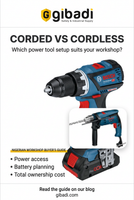


A cordless drill can make moving between workstations easier. A corded tool can be a practical choice for a fixed bench with a suitable power supply. Neither is automatically the better investment.
For Nigerian workshops, contractors and maintenance teams, the useful question is not simply “Which is more powerful?” It is “Which setup helps us complete our actual jobs with fewer interruptions and a manageable ownership cost?”
Here is how to compare corded and cordless power tools before your next purchase.
Start with the job, not the power source
List your most frequent tasks before comparing tools. Drilling timber for furniture assembly is different from drilling masonry. Occasional installation work is different from repeated cutting at a production bench.
Record the materials, typical hole sizes or cutting depths, frequency of use and where the work happens. Then compare the specifications of individual tools against those requirements.
Do not use battery voltage or a corded tool’s input wattage alone as a performance ranking. Check the manufacturer’s stated capacities and intended applications for the exact model.
When corded tools are worth considering
Corded tools are worth evaluating for a fixed workstation where an appropriate electricity supply is available. They do not require battery changes during use, although they still need to be operated within the manufacturer’s usage limits.
For a workshop that already has suitable power infrastructure, a corded option may avoid the additional purchase of batteries and chargers. Compare actual quotations rather than assuming every corded model costs less.
The trade-off is mobility. Cable routing, access to sockets and the suitability of any extension equipment need consideration. Have electrical arrangements assessed by a competent person and follow the tool manufacturer’s instructions.
When cordless tools can improve workflow
Cordless tools can be useful for installation teams, maintenance staff and tradespeople moving frequently between work areas. They reduce reliance on a nearby socket during the task.
However, cordless does not mean independent of electricity. Batteries still need charging, and a busy team needs a plan for charged spares, charging locations and downtime.
Runtime varies with the tool, battery, material and workload. Avoid buying on an unsupported promise that one battery will last a whole shift. Where practical, evaluate the setup on representative work.
Compare the complete setup, not just the tool price
A tool-only cordless price is not directly comparable with a ready-to-use kit. Confirm exactly what each quotation includes.
| Cost or requirement | Corded setup | Cordless setup |
|---|---|---|
| Initial purchase | Tool and required accessories | Tool, compatible batteries and charger, unless already owned |
| Power planning | Suitable supply at the work location | Charging access and enough charged batteries for the workload |
| Future purchases | Assess each tool against its application | Check whether new tools fit the existing battery platform |
| Ongoing ownership | Servicing, accessories and cable condition | Servicing, accessories and battery condition or replacement |
For both options, include the correct bits, blades or discs, maintenance needs and manufacturer-specified protective equipment in your planning.
Check battery compatibility before expanding
Owning batteries from a brand does not automatically mean they will work with every cordless tool carrying that brand’s name. Compatibility can depend on the platform and model.
Record your existing battery and charger model numbers. Ask for written confirmation of compatibility with the proposed tool before ordering. Check whether the quoted item is a bare tool or a kit, and which batteries and charger are included.
A consistent platform can simplify purchasing, but it should not override suitability for the job. Choose the application first, then assess platform convenience.
Build around your workshop’s power reality
Review how often work moves away from fixed sockets and how interruptions affect your schedule. If a generator or other backup supply is involved, have a qualified professional confirm suitability for the tool or charger. Do not assume any available backup source is appropriate.
For some teams, a mixed setup is the most practical: corded equipment for selected bench tasks and cordless tools for mobile work. Base that decision on your workload rather than a rule that everything must use the same power source.
A simple decision checklist
- Mostly fixed-location work? Evaluate a corded model alongside a suitable cordless alternative.
- Frequent movement between tasks or sites? Consider the mobility benefits of cordless tools.
- Already own cordless equipment? Confirm exact battery and charger compatibility.
- Long or demanding jobs? Check rated application capacity, usage instructions and a realistic power or battery plan.
- Comparing quotations? Compare complete usable setups, not headline tool prices.
Prepare a better power-tool enquiry with Gibadi
When requesting a quotation from Gibadi, describe the task and material, how often the tool will be used, and whether the work is mainly bench-based or mobile. Include any preferred model and the model numbers of batteries or chargers you already own.
Ask for the exact tool reference, included accessories, applicable warranty terms and current availability. For cordless options, request a clear breakdown of the tool, batteries and charger.
The best choice is the tool setup that suits your work, not simply the one with the biggest number on the box.